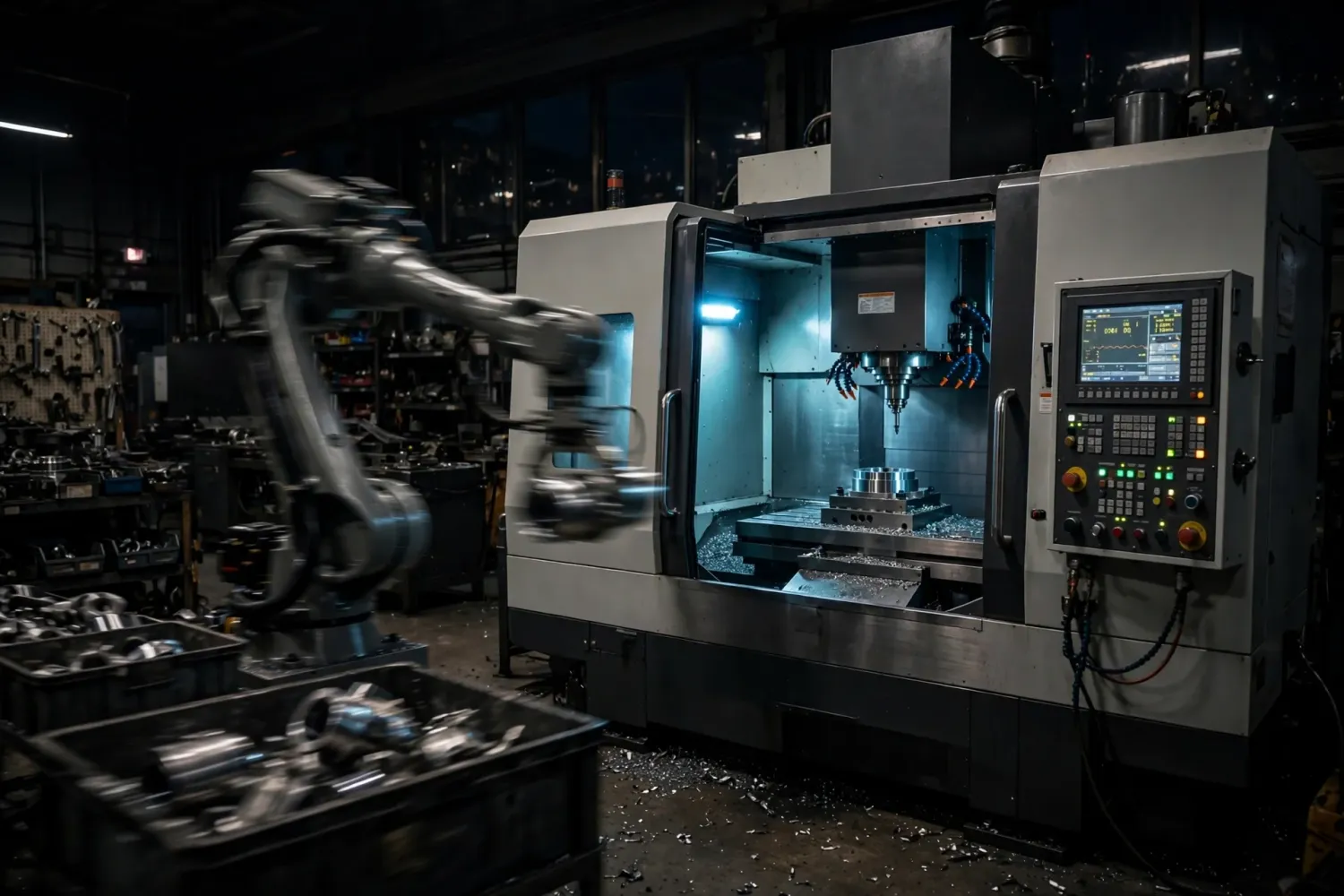
Automatic cycle execution is not autonomous production. Any modern CNC can repeat a proven toolpath, and touch probes or tool setters can check basic status. What actually decides how long an unmanned run lasts is what happens when inserts wear, chips pack up, or thermal growth pushes a feature out of tolerance — whether the cell can evaluate the condition, protect the spindle and workpiece, and recover the cycle without an operator in the building.
That distinction is the whole article. Everything below is the shop-floor engineering behind it.
The definition, up front
Automatic execution: The CNC runs a programmed toolpath reliably. Spindle probes and tool setters may check basic status, and the machine does what the G-code tells it to do — for as long as nothing goes wrong.
Autonomous production: The cell runs a closed-loop process — detect → judge → protect → recover. When cutting conditions shift, the system catches the deviation, makes the right call (updating a wear offset, swapping in a redundant sister tool, or skipping a bad pallet), protects the machine and workpiece, and keeps making good parts without a machinist on the floor.
Most shops that advertise “lights-out capability” are really describing the first one. The second one is what determines whether the spindle is still cutting at 6 AM — and whether the parts sitting in the pallet pool actually pass QC.
| Failure Mode | Automatic Execution | Autonomous Production |
|---|---|---|
| Tool breakage | Next tool keeps feeding into a broken drill or tap, trashing the part and holder | Non-contact detection stops the cycle or calls a sister tool — e.g., Renishaw’s TRS2 laser checks a tool in ~1 second, down to ~0.2 mm diameter |
| Tool wear | Size drift builds up across the night shift and is only caught at morning CMM inspection | In-cycle probing measures critical features and auto-updates wear offsets; out-of-tolerance parts are quarantined |
| Thermal drift | Overnight temperature swings and spindle growth push tight bores out of spec late in the run | In-machine probing or laser measurement tracks thermal growth and feeds compensation back into the CNC control automatically |
| Misloaded blank | Crashes a tool or crushes a fixture at 2 AM, halting the entire cell | Spindle probe flags the misload before cutting, locks out that pallet, and indexes to the next job |
| Result | ”Lights-out” until the first alarm stops the spindle | Documented unattended spindle hours — e.g., 18–20 hrs/day on a palletized Mazak 5-axis cell |
The three failure modes (what each destroys at 2 AM)
Unattended machining rarely fails in exotic ways. It fails in three everyday shop-floor ways, and the difference between a cell that runs all night and a cell that claims to is whether each failure mode has a programmed recovery path.
1. Tool wear — gradual, silent, compounding. Flank and crater wear don’t announce themselves; they creep up over hours and push diameters or depths a few microns at a time. In work-hardening superalloys, wear is non-linear — an end mill or insert that looks stable at midnight can notch, lose its edge, and go out of tolerance by 3 AM. This is the failure mode that separates fixed tool-life timers (automatic execution) from probe-driven offset compensation and load-triggered sister tooling (autonomous production).
2. Chip evacuation failures — birdnesting, recutting, and chip packing. A birdnest of stringy swarf wrapped around a boring bar or toolholder doesn’t just ruin surface finish — recutting chips spikes spindle load and cascades into catastrophic tool breakage or a scrapped workpiece. Overnight chip control isn’t housekeeping; it’s an active failure mode that requires high-pressure through-spindle coolant, chip-breaking toolpaths, or washdown verification. Without a plan, running unmanned is a gamble.
3. Dimensional drift — thermal growth over a long run. A machining center that holds ±0.0005 in. (±0.013 mm) at 6 PM will grow and shift thermally by 2 AM as spindle bearings, ballscrews, and shop ambient temperatures change. Features move. By 6 AM, half the pallet is scrap unless the cell measured that drift in-process and updated its work or tool offsets while no one was watching.
What “autonomy” actually requires: the detect → judge → protect → recover loop
Each stage of the closed loop maps to concrete, shop-proven hardware and control logic — not a marketing buzzword.
Detect. Broken-tool and wear detection has to be fast and non-contact, or programmers will skip it to save cycle time. Renishaw’s TRS2 uses a laser beam to check rotating tools down to roughly 0.2 mm diameter in about one second per check, mounted outside the primary work envelope so it doesn’t eat into chip-to-chip time. Blum-Novotest’s in-machine laser measuring systems go further: checking tool length, radius, breakage, runout, and spindle thermal growth — feeding compensation directly back into the CNC control. On the R&D side, Oak Ridge National Laboratory published a tactile inspection method in 2026 (Wear, DOI: 10.1016/j.wear.2025.206422) — an elastomeric sensor pad that presses against the cutting edge and evaluates wear via computer vision in seconds at 98% accuracy, unaffected by coolant mist or shop lighting. Notably, the researchers targeted the exact alloys that punish unmanned cells: titanium and nickel-based superalloys. It’s still lab-stage rather than a catalog item, but it shows where high-resolution edge inspection is heading.
Judge. Detection without decision logic is just a red stack light blinking in an empty building. The judgment layer turns probing data into control decisions: SPC Innovations’ “Detector” system combines in-machine broken-tool checks with in-process part gaging, measuring critical features mid-cycle so tool wear offsets update automatically — while misloaded blanks get flagged and skipped before the first tool enters the cut. On the software side, MachineMetrics previewed “Tool Intelligence” at IMTS 2026, linking tool wear patterns to live spindle load and machine data so cells pull tools based on actual cutting condition rather than conservative fixed part counts (with full production rollout slated for Q4 2026). That is vendor roadmap territory rather than third-party validation, but it illustrates how the decision layer is moving into the control loop.
Protect. Marposs describes this architecture as sight → judgment → reflex: in-process gaging provides sight, control analytics handle judgment, and real-time machine protection / collision and overload monitoring act as the reflex that saves the spindle. Their partnership with TITANS of CNC, announced at IMTS 2026, focuses specifically on lights-out manufacturing by tying in-process measurement and real-time feedback to machine protection. When the industry’s core metrology suppliers build their roadmaps around detect-judge-protect loops, the architecture is no longer theoretical.
Recover. The loop only pays off if the spindle goes back to making chips. In practice, recovery means automatic thermal compensation written to work coordinates, closed-loop wear offset adjustments from in-cycle probing, automatic quarantine of out-of-spec pallets so the rest of the queue continues, and — in well-integrated cells — automatic re-machining passes when a semi-finish bore probes slightly undersize.
Here is what the complete loop looks like on a real shop floor: Van Riet, an eight-person precision shop in the Netherlands, runs a palletized Mazak 5-axis cell programmed with ESPRIT CAM for automated in-cycle probing. Dimensional deviations are compensated automatically, and out-of-tolerance finishing operations re-run before the pallet leaves the workzone. Documented runtime: 18–20 hours per day. As their team puts it: “When we arrive in the morning, we can be assured the parts are correct.” That is autonomous production backed by spindle logs.
The honest critique
Not every “lights-out” shop is running autonomously, and engineering buyers should watch out for the two most common shortcuts:
First, many operations marketed as lights-out simply dial feeds and speeds way back to baby the tools through the night. That isn’t autonomy — it’s running scared with the lights off. It still fails the moment an insert chips unexpectedly, and it gives away much of the throughput the automation was supposed to deliver.
Second, tool and process monitoring is the most under-engineered part of unattended cells. Buying a pallet pool or a 6-axis robot while cutting corners on broken-tool detection, spindle load monitoring, and in-cycle probing is a classic false economy. A shop that bought the robot to load blanks but skipped closed-loop feedback hasn’t built autonomous production — it has built automatic execution with an expensive loader.
The high-mix shift
The business case for unattended machining has changed. It used to be strictly a high-volume play — replacing an operator standing in front of a machine loading the same bracket a thousand times. Today, the push is high-mix, low-volume (HMLV): keeping an expensive 5-axis or mill-turn asset cutting overnight across mixed pallets of small-batch parts. Modern automation is less about eliminating an operator on a dedicated line and more about getting 18 hours of spindle utilization out of a flexible job-shop machine.
Machine tool builders are designing directly for this: Mills CNC’s SYNERGi T Series cells, shown at MACH 2026, are built around unattended batch flexibility, while Hurco’s ProCobots cells pair 5-axis machining centers with 6-axis robots to run everything from one-off prototypes to short production runs. Autonomy matters most where lot sizes don’t justify a dedicated night-shift operator — which describes the majority of precision contract manufacturing.
Why hard alloys are the real test
Work-hardening alloys — MP159, Inconel 718, Ti-6Al-4V — burn through carbide faster and far less predictably than aluminum or mild steel. That unpredictability is what breaks basic automatic execution: fixed tool-change intervals assume steady, linear flank wear, and superalloys don’t cooperate. A slight dwell or a worn edge work-hardens the cut surface instantly, spiking cutting forces on the next pass. Paradoxically, the materials with the highest unmanned risk are also the ones where a closed detect → judge → protect → recover loop pays for itself fastest, because long cycle times and high machine rates make overnight spindle hours invaluable.
If you are specifying or sourcing components in these alloys, material behavior and machining control can’t be separated — we broke down why MP159 (AMS 5842) is specified for extreme loads despite how punishing it is to cut. The shops that can run alloys like that through the night are the ones that closed the control loop.
Buyer’s checklist: what to ask a shop that claims “lights-out capability”
- What detects a broken or chipped tool mid-cycle, and how fast? (You want to hear non-contact laser tool setting, spindle load monitoring, and sister-tool logic — not “the day-shift operator checks the tools in the morning.”)
- Do you probe critical features in-cycle and auto-update wear offsets — or just inspect on the CMM the next day? Morning-only inspection is automatic execution with a scrap report.
- How do you compensate for thermal growth across a 10+ hour overnight run? If the answer is only “we run a 15-minute spindle warmup macro,” tight tolerances won’t survive midnight temperature swings.
- What happens if a blank is misloaded or a feature probes out of spec at 2 AM? The right answer is automatic pallet quarantine and indexing to the next pallet — not a crashed spindle or a stalled cell.
- Can you show your unattended spindle-hour logs? A real autonomous cell like Van Riet’s can point to 18–20 hours a day of documented runtime. Ask to see the utilization record, not just the robot in the lobby.
At Oakmet, these are the exact questions we ask when auditing and qualifying precision machine shops in our production network — so our customers don’t get surprised by overnight scrap. True unattended capability is what separates a shop that masters automation from a shop that simply bought a robot.
FAQ
What is lights-out machining? Unattended CNC operation, typically run overnight or over weekends. Running a long cycle with no one in the building is only automatic execution. True autonomous production requires a closed-loop process — detect, judge, protect, recover — so the cell catches wear or drift and corrects itself on the fly.
Which parts qualify for lights-out machining? Parts with proven, repeatable processes: predictable tool life, reliable chip evacuation, in-cycle probing, and a programmed response for every likely failure mode. Work-hardening alloys like MP159 or Inconel qualify only when the full closed loop is active, because tool wear in superalloys accelerates unpredictably.
What does lights-out capability cost to set up? The investment covers pallet or robot handling, in-process probing, and tool monitoring. Tool monitoring is the most commonly underestimated piece — buying the cheapest detector is a false economy because reliable detection and recovery dictate unattended output more than the robot itself.
Is lights-out machining safe to run unattended? Only when chip management and overload protection are engineered into the process. Chip birdnesting and recutting aren’t minor housekeeping issues; they lead directly to broken tools, ruined fixtures, or fire hazards. High-pressure coolant, load monitoring, and automatic pallet quarantine are essential parts of the autonomy loop.
How long can a CNC really run unattended? It depends on the closed-loop recovery logic, not the cycle length. Well-engineered cells — such as a palletized Mazak 5-axis with automated in-cycle probing and offset compensation — routinely log 18–20 hours per day. Shops that merely dial down feeds and speeds run only until the first unexpected insert failure.
Automatic execution vs. autonomous production — what’s the difference? Automatic execution repeats programmed G-code for as long as nothing goes wrong. Autonomous production closes the loop: when cutting edges wear, chips pack up, or thermal growth shifts a tolerance, the system evaluates the condition, protects the workpiece and spindle, and resumes production automatically. That closed loop — not the cycle length — decides how long unmanned machining lasts.